What is eSports? A look at an explosive, billion-dollar industry

The esports industry is projected to generate over $1.5 billion in global revenue by 2020. 2018 saw a 38% increase in revenue from the previous year, and the number of occasional viewers grew by 35%, hitting 215 million. That’s 50 million more than that of esports enthusiasts, long seen as the primary audience.
This is revolutionary data.
Numbers clearly show that the definition of sports has changed, a shift rocking traditional sports associations to the core. To combat a sharp decline in viewership, major sports franchises are searching for ways to partner with esports leagues, teams and players.
Competitive gaming now has a $10 million, 100,000 ft2 stadium in the U.S. The industry is on fire. Here’s how it happened, what it means, and what to expect.
Where we’re at
Esports are a team-based competition. Two teams stand against each other on an even playing field. Joining a team takes skill and practice. Teamwork and dedication are required. The dynamic is just like sports, without the athleticism.
Viewers of esports spent 17.9 million hours watching their gaming heroes in the first quarter of 2018 alone. The most popular game is currently Dota 2, followed by League of Legends and Counter Strike: Global Offensive.
Fans find content mainly on YouTube’s gaming channel or on Twitch, a live streaming video platform for gaming. The website welcomes some of the top-ranked gamers, who show their skills to millions of viewers. Providing those viewers with cutting-edge choices across multiple platforms means entering a whole new market.
Being a professional esports player is now a lucrative position. One famous gamer, Ninja, gains about 50,000 viewers per stream. By playing Fortnite and PlayerUnknown’s Battlegrounds — often from his own home — he makes about $500,000 annually.
And although Ninja is doing well, by 2021, mobile esports athletes are expected to become millionaires by winning a single event.
Joining the fun
The impact of esports is widespread, opening up opportunities for established businesses outside of the competitive gaming and tech industry.
Media, brands and entertainment companies are capitalizing on live events and streamed content. This previously out-of-reach market is now open to both time-tested and innovative advertising business models.
Investors are taking notice. Since 2012, esports companies have raised more than $5 billion in venture capital funds.
Of course, a tech-savvy audience expects exceptional access and convenience. That applies to online content, mobile and smart TV apps, as well as the in-stadium experience. Whatever the platform, STRV can create and manage it — because connecting people to information is what we do.
Where is the revenue coming from?
Most notably? Sponsorship deals — with teams, players and events. Expected to reach $655 million by 2020, sponsorship is esports’ largest revenue stream.
Big names are taking part in the revolution. Red Bull and Coca-Cola have sponsored gaming events. Major League Soccer is creating its own FIFA esports league. And Michael Jordan has invested in aXiomatic, the parent company of Team Liquid — one of the most respected brands in esports.
Media rights are another source of growth, attracting companies like ESPN and Facebook. Expected to bring in $340 million by 2020, deals providing perks like exclusive content are all the rage.
Despite being rooted in the digital sphere, esports have advanced into the world of live entertainment. In 2017, Beijing National Stadium brought together the best gamers for an international competition. Tickets sold out in minutes — and they weren’t cheap.
Coming up next…
Mainstream expansion is around the corner. Television distribution deals, making content more accessible, and connecting with famous brands and the celebrity culture — this is the future of esports.
Non-gamers are taking notice. U.S. media conglomerates like Disney, Comcast and AT&T are looking to offer content. It’s all about catering to millennials — and millennials are demanding options that let them watch competitive gaming whenever and wherever they want.
It’s precisely this demand that gives the industry endless digital potential, making it a perfect playground for designers and developers. That’s why, here at STRV, we are ecstatic to be a part of the revolution.
Thanks to nearly two decades of experience with web, mobile, and Smart TV applications design and engineering, we consistently produce high-performing tech solutions respected by Silicon Valley and our peers. And we still think it’s all really, really fun.
Our biggest esports project to date was the recent upgrade of TSM’s web presence. The goal was to make the esports team’s site visually attractive and accessible while coinciding with the brand’s business goals and needs.
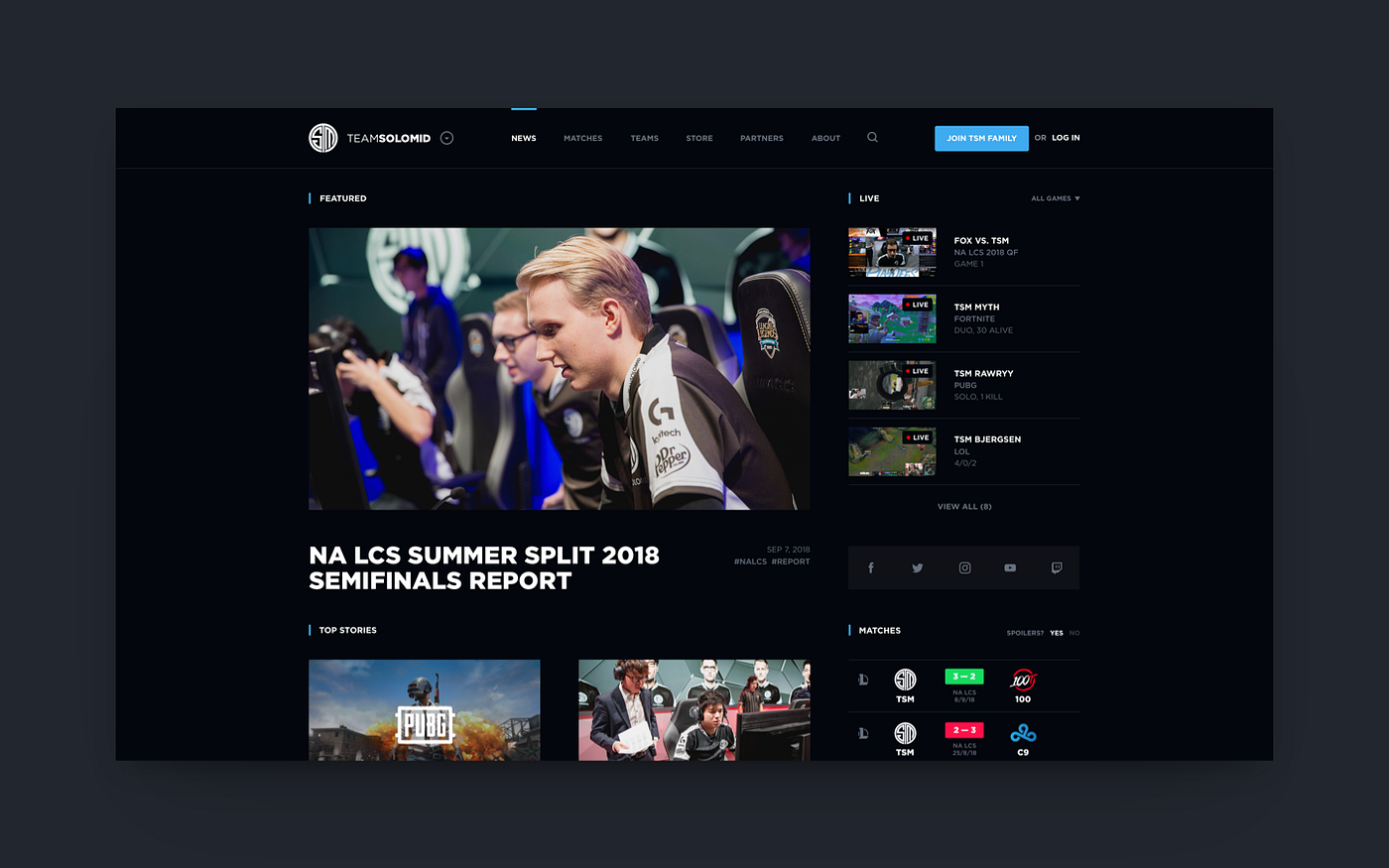
Improvements were needed in areas like website navigation, visual consistency, the general website layout and web design direction, and the business aspect. There was room to set up an entirely new online store, new interactive components and sections aimed at building fan experiences, and more.
With personalization as one of our key objectives, we incorporated a variety of optional notifications and reminders. For an uninterrupted reading experience, we modified ad placement and included a switch between dark and light mode. And for immediacy, we kept a feed of all ongoing player/team live streams as one of the main page’s front-and-center features.
Successfully completing this complex project made us even more excited about what’s ahead. It’s clear that esports are the future. We’re curious to see who is going to lead the way — and we’re ready to collaborate in getting them there.